
Oven and Range Problems: Common Issues, Causes, and When to Call a Professional
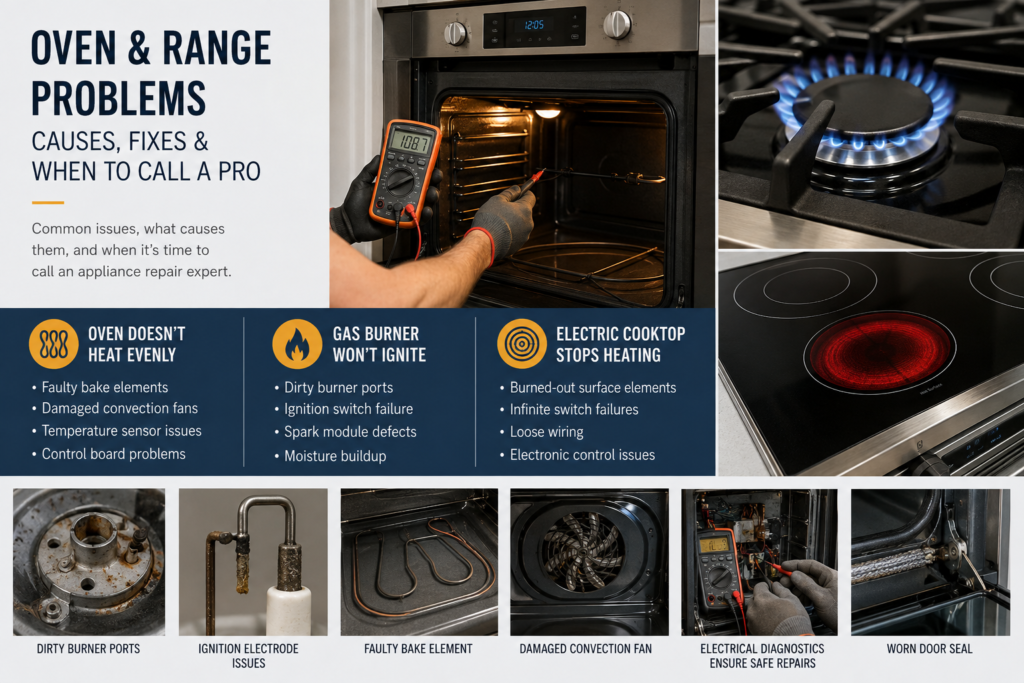
Your oven and range are among the hardest-working appliances in the kitchen. From everyday meals to holiday cooking, these appliances are exposed to high temperatures and repeated heating and cooling cycles. Over time, that constant use can cause certain components to wear out.
When an oven stops heating evenly, a gas burner won’t ignite, or an electric cooktop suddenly stops getting hot, it can be difficult to know whether the problem is something simple or a sign of a more serious component failure.
As appliance repair technicians, we regularly diagnose oven, range, and cooktop problems from many of the major brands found in homes today. Some issues are caused by routine wear or food debris, while others involve heating elements, ignition components, sensors, switches, wiring, or electronic control boards.
The good news is that many cooking appliance problems are repairable. The important part is identifying the actual cause instead of replacing parts unnecessarily.
In this guide, we’ll look at some of the most common oven and range problems, what causes them, and when it’s best to call an experienced appliance repair professional.
Common Oven and Range Brands We Service
Oven and range problems aren’t limited to one particular manufacturer. Even reliable appliances eventually require maintenance or repairs.
Common and major brands include:
- Whirlpool
- GE
- Frigidaire
- Samsung
- LG
- KitchenAid
- Maytag
- Bosch
- Electrolux
- Kenmore
- Amana
- Viking
- Thermador
- Wolf
- Miele
- Café
- JennAir
- Dacor
Each brand may use different components and control systems, but many of the symptoms are similar. Whether you have a basic electric range or a high-end gas range with convection cooking and electronic controls, understanding the warning signs can help you determine when professional service is needed.
Oven Doesn’t Heat Evenly
One of the most common complaints we hear is that an oven isn’t cooking food evenly.
You might notice that cookies on one side of the baking sheet are darker than those on the other side. A casserole may be hot in the middle but undercooked around the edges. You may also find that food takes much longer to cook than the recipe recommends.
There are several possible causes.
Faulty Bake Element
Electric ovens typically use a bake element at the bottom of the oven to generate heat. Depending on the model, there may also be a broil element at the top.
When the bake element starts failing, it may not heat properly or may stop working altogether.
A damaged element can sometimes be identified visually. You may notice cracks, blistering, discoloration, or a section that doesn’t glow when the oven is operating.
However, not every failed heating element has visible damage. Electrical testing is often necessary to determine whether the element is receiving the correct voltage and functioning properly.
Damaged Convection Fan
Many modern ovens include a convection feature that uses a fan to circulate hot air throughout the oven cavity.
The goal is to create more consistent temperatures and improve cooking performance.
If the convection fan isn’t operating correctly, you may notice uneven cooking, longer cooking times, unusual fan noises, or poor convection performance.
A fan motor can wear out over time. The fan blade can also become damaged or obstructed by debris.
If your oven makes a rattling, grinding, or unusual humming sound when convection mode is running, the fan system should be inspected.
Temperature Sensor Problems
The temperature sensor monitors the temperature inside the oven and communicates that information to the control system.
If the sensor becomes inaccurate, the oven may believe it has reached the correct temperature when it hasn’t.
Symptoms can include:
- Food consistently undercooking
- Food burning unexpectedly
- Oven temperature fluctuating
- Longer preheating times
- Oven temperature being significantly different from the selected setting
A temperature sensor can be tested to determine whether it is operating within the manufacturer’s specifications.
Control Board Issues
Modern ovens rely heavily on electronic controls.
The control board manages functions such as temperature, heating cycles, timers, convection, and other settings.
If the control board develops a problem, the oven may exhibit several unusual symptoms.
For example, the oven may not heat even though the heating elements appear to be intact. The display may show error codes, buttons may stop responding, or the appliance may turn itself off unexpectedly.
Control board problems can be more complicated than replacing a heating element because the technician must determine whether the board itself is defective or whether another component is causing the problem.
Oven Calibration
Sometimes an oven is technically working but isn’t accurately maintaining the temperature displayed on the control panel.
For example, you may set the oven to 350°F, but the actual temperature may be significantly higher or lower.
Ovens naturally cycle on and off to maintain temperature, so some variation is normal. However, significant temperature differences can affect cooking results.
Professional temperature testing and calibration can help restore more consistent cooking performance when the appliance supports calibration.
Gas Burner Won’t Ignite
Gas ranges are popular because they provide fast, responsive heat. However, when a burner won’t ignite, it’s important to determine whether the issue is simple debris or a failed ignition component.
Common causes include:
- Dirty burner ports
- Failed ignition switch
- Defective spark module
- Moisture around the burner
- Damaged ignition electrode
- Gas supply problems
Dirty Burner Ports
Food spills and grease can block the small openings around a burner.
When the ports are clogged, gas may not distribute evenly, preventing the burner from igniting correctly.
You may notice a weak flame, uneven flames, or a burner that clicks repeatedly without lighting.
Cleaning the burner components according to the manufacturer’s instructions may resolve minor blockage issues.
However, aggressive cleaning or using sharp objects can damage burner components, so care should be taken.
Moisture Around the Burner
If you recently cleaned the cooktop or had a pot boil over, moisture may have entered the burner area.
A wet ignition electrode may fail to create the spark needed to ignite the gas.
Allowing the area to dry completely may resolve the issue.
If the burner still clicks without igniting after the area is dry and the burner components are properly positioned, further diagnosis may be necessary.
Ignition Switch Failure
Gas ranges commonly use an ignition system that activates when you turn the burner knob.
If the switch fails, the spark may not be generated correctly.
In some cases, you may hear clicking from other burners but not from the affected burner. This can point toward an ignition switch or related wiring problem.
Spark Module Defect
The spark module supplies the electrical signal needed to create the ignition spark.
If the module fails, multiple burners may stop sparking at the same time.
This is different from a single clogged burner because the issue affects the ignition system rather than just one burner port.
A technician can test the ignition system to determine whether the spark module, switches, electrodes, or wiring are responsible.
Electric Cooktop Stops Heating
Electric cooktops use heating elements or radiant heating systems to generate cooking heat.
When one burner suddenly stops heating, several components could be responsible.
Common causes include:
- Burned-out surface element
- Failed infinite switch
- Loose or damaged wiring
- Electronic control problems
- Damaged receptacle or terminal connection
Burned-Out Surface Element
Traditional electric cooktops use removable heating coils or integrated heating elements.
With regular use, these elements eventually wear out.
A failed element may remain completely cold even when the control is turned to a high setting.
In some cases, the element may show visible damage, but electrical testing is still the best way to confirm the failure.
Infinite Switch Failure
The infinite switch controls the amount of power sent to an electric heating element.
When you turn the knob from low to high, the switch regulates how much power reaches the element.
If the switch fails, the burner may:
- Not heat
- Stay on high
- Cycle incorrectly
- Heat intermittently
- Fail to respond to the control setting
Because the switch is part of the electrical system, diagnosis should be performed carefully.
Loose Wiring
High temperatures and repeated electrical cycles can eventually affect wiring and terminal connections.
A loose connection may cause intermittent heating or prevent an element from working altogether.
Electrical problems should never be ignored. A loose or damaged connection can generate excessive heat and potentially damage surrounding components.
Electronic Control Problems
Modern glass cooktops and induction-style cooking appliances may use electronic controls instead of traditional mechanical switches.
If the control system fails, one or more cooking zones may stop working.
Error codes, flashing displays, unresponsive touch controls, or burners that don’t respond correctly can indicate an electronic problem.
These systems require proper diagnostic procedures because replacing a control board without confirming the cause can be expensive and unnecessary.
Why Your Oven Takes Too Long to Preheat
Another common complaint is an oven that takes much longer than usual to reach the selected temperature.
A slow preheat can be caused by:
- Weak bake element
- Failed broil element
- Temperature sensor problems
- Electrical supply issues
- Control board malfunction
- Damaged convection components
If the oven previously preheated quickly but gradually became slower, that change is worth paying attention to.
A weakening heating element may still produce some heat while no longer operating at full capacity.
Oven Takes Too Long to Cook
Long cooking times don’t always mean the oven isn’t heating at all.
If the temperature is consistently lower than the selected setting, food will take longer to cook.
For example, a recipe designed for 350°F may require significantly more time if the oven is actually maintaining a much lower temperature.
A technician can test the oven temperature and heating components to determine whether the appliance is operating correctly.
Oven Door Problems
The oven door plays an important role in maintaining temperature.
If the door doesn’t close properly, heat can escape from the oven cavity.
Common causes include:
- Worn door gasket
- Damaged hinges
- Misaligned door
- Broken hinge components
- Damaged glass
A damaged gasket may allow heat to escape around the edges of the door. You may notice excessive heat around the exterior or longer cooking times.
If the door doesn’t close securely, it’s worth having the appliance inspected.
Self-Clean Cycle Problems
Self-cleaning ovens reach extremely high temperatures during the cleaning cycle.
While the self-clean feature is convenient, it places significant thermal stress on oven components.
Some appliances may experience problems after running a self-clean cycle, including:
- Door locking issues
- Control board errors
- Heating failures
- Blown thermal components
- Temperature sensor problems
If your oven stops working immediately after a self-clean cycle, don’t assume the entire appliance is ruined.
A technician can inspect the safety thermostat, control system, heating components, and other parts to determine what happened.
Gas Oven Problems
Gas ovens have their own set of components that can fail over time.
Common problems include:
- Oven won’t ignite
- Weak burner flame
- Oven doesn’t maintain temperature
- Igniter glows but doesn’t ignite
- Long preheating times
- Gas odor
One common failure involves the oven igniter.
The igniter needs to reach a specific temperature to ignite the gas safely. A weak igniter may glow but fail to ignite the burner correctly.
Gas valve problems, temperature sensors, and control components can also contribute to heating issues.
Because gas appliances involve combustion and fuel, gas-related repairs should be handled by a qualified professional.
Common Warning Signs You Shouldn’t Ignore
Some cooking appliance symptoms deserve immediate attention.
Stop using the appliance and seek professional service if you notice:
- Strong gas odors
- Smoke
- Sparks
- Burning electrical smells
- Repeated circuit breaker trips
- Exposed or damaged wiring
- Extreme overheating
- A burner that remains on after the control is turned off
Don’t attempt to diagnose or repair a gas leak yourself.
If you smell gas, leave the area and follow appropriate local gas-safety procedures before arranging professional service.
Simple Oven and Range Maintenance Tips
Regular maintenance can help reduce unnecessary wear and keep your cooking appliances operating properly.
- Keep Burner Ports Clean: For gas ranges, clean burner components regularly according to the manufacturer’s instructions. Remove food debris before it accumulates around the burner openings.
- Clean Spills Promptly: Food spills can become difficult to remove when repeatedly exposed to high temperatures. Cleaning spills after the appliance has cooled can help prevent buildup and reduce odors.
- Avoid Blocking Oven Vents: Ovens need proper airflow. Avoid covering vents or placing objects where they can restrict ventilation.
- Don’t Use Aluminum Foil Incorrectly: Many manufacturers warn against placing foil directly on the bottom of an oven because it can interfere with airflow, damage surfaces, or affect heating. Always follow the manufacturer’s instructions for your specific model.
- Check the Door Seal: Inspect the oven gasket occasionally for cracks, tears, or sections that have become flattened. A damaged gasket can allow heat to escape and increase cooking times.
- Don’t Slam the Oven Door: Repeatedly slamming the door can damage hinges, glass, and other components.
Closing it gently helps extend the life of the appliance.
Keep Cooktop Controls Clean
Grease and food residue can build up around knobs and touch controls. Clean them according to the manufacturer’s instructions and avoid allowing excessive moisture into electronic controls.
When Should You Call an Appliance Repair Technician?
Not every oven or range problem requires professional service.
Cleaning burner ports, removing food debris, and checking obvious settings are reasonable maintenance steps for many homeowners.
However, professional diagnosis is recommended when the problem involves:
- Electrical wiring
- Heating elements
- Control boards
- Temperature sensors
- Ignition systems
- Gas valves
- Repeated breaker trips
- Persistent error codes
Trying to replace electrical or gas components without the correct tools and experience can create additional damage or a safety hazard.
Professional diagnostics can also save money by identifying the actual failed component rather than replacing several parts through trial and error.
Repair or Replace Your Oven or Range?
When an oven or range stops working, many homeowners immediately assume they need a replacement.
That’s not always true.
A failed heating element, temperature sensor, ignition component, switch, gasket, or other individual part may be repairable at a fraction of the cost of a new appliance.
The decision depends on several factors, including:
- Age of the appliance
- Overall condition
- Cost of replacement parts
- Labor cost
- Availability of parts
- Frequency of previous repairs
- Cost of a comparable replacement
A professional inspection can help you determine whether repairing the appliance makes financial sense.
Final Thoughts
Ovens, ranges, and cooktops are built to handle high temperatures and frequent use, but no appliance lasts forever. Constant heating and cooling cycles naturally put stress on heating elements, sensors, switches, wiring, ignition components, and electronic controls.
An oven that doesn’t heat evenly may have a faulty bake element, damaged convection fan, temperature sensor problem, or control board issue. A gas burner that won’t ignite could have clogged ports, moisture, a failed ignition switch, or a defective spark module. An electric cooktop that stops heating may have a burned-out element, failed infinite switch, loose wiring, or electronic control problem.
Whether you own a Whirlpool, GE, Frigidaire, Samsung, LG, KitchenAid, Maytag, Bosch, Electrolux, Kenmore, Viking, Thermador, Wolf, Miele, Amana, or another major appliance brand, recognizing these warning signs can help you address problems before they become more expensive.
Regular cleaning and proper use can extend the life of your appliance, but when a problem involves gas, electricity, heating components, or electronic controls, professional diagnosis is the safest approach.
If your oven isn’t heating evenly, your gas burner won’t ignite, or your electric cooktop has stopped heating, don’t automatically assume you need a new appliance. A qualified appliance repair technician can diagnose the problem, identify the failed component, and help you determine whether repair is the right solution.